

American WW2 battlefield tours in Belgium — from the liberation to the Bulge
American WW2 battlefield tours in Belgium usually mean the Battle of the Bulge. But the American war here began three months earlier. In September 1944 the US First Army crossed into southern Belgium and liberated much of the east of the country, including Liège, before running up against the German border and the West Wall. In December, the German offensive in the Ardennes struck the same American divisions on the same ground.
Two American military cemeteries in Belgium hold the men of both campaigns. Many visitors come for a single grave; others come for a division, a battle or a story their father never told. Each tour is private and built around that.

Henri-Chapelle American Cemetery
On a ridge between Liège and Aachen lies the Henri-Chapelle American Cemetery, where nearly 8,000 Americans are buried. Most fell in the advance to the German border in the autumn of 1944, in the Hürtgen Forest and around Aachen, or in the Battle of the Bulge. From the colonnade on a clear day you look east towards Germany — the direction these men were advancing.
The cemetery is maintained by the American Battle Monuments Commission, which also records the names of those still missing on its walls. Its staff can help with flowers and, on request, with the visit to a specific grave.
The Ardennes American Cemetery at Neupré
South of Liège, the Ardennes American Cemetery at Neupré is smaller and quieter. Among its burials are a large number of airmen of the US Army Air Forces, alongside soldiers who fell in the Bulge and in the drive into Germany. The two cemeteries are about forty minutes apart and are often visited on the same day when a family has relatives in both, or wants to understand the difference between them.


Bastogne and the Mardasson Memorial
Bastogne is the American name everyone knows. The 101st Airborne, with Combat Command B of the 10th Armored Division and other units, held the town under siege from 20 December 1944 until Patton’s Third Army broke through on 26 December. On 22 December, when German officers delivered a demand for surrender, Brigadier General Anthony McAuliffe answered with one word: “Nuts!”
On the hill outside the town, the Mardasson Memorial is shaped as a five-pointed star, with the names of the then 48 American states carved around it. Inside the town, the Bastogne Barracks and the 101st Airborne Museum tell the story of the siege. The Easy Company part of it has its own page, the Band of Brothers tour in Bastogne, and the full Bastogne route is on the Bastogne 360 day tour page.
Elsenborn Ridge and the northern shoulder
In the north, the American 2nd and 99th Infantry Divisions held Elsenborn Ridge against repeated attacks in the first days of the offensive, denying the Germans the roads they needed to the west. It is a less visited part of the battle and, for many veterans’ families, the most important. The full route — Lanzerath, Krinkelt-Rocherath, Baugnez and La Gleize — is on the Northern Shoulder private tour page.
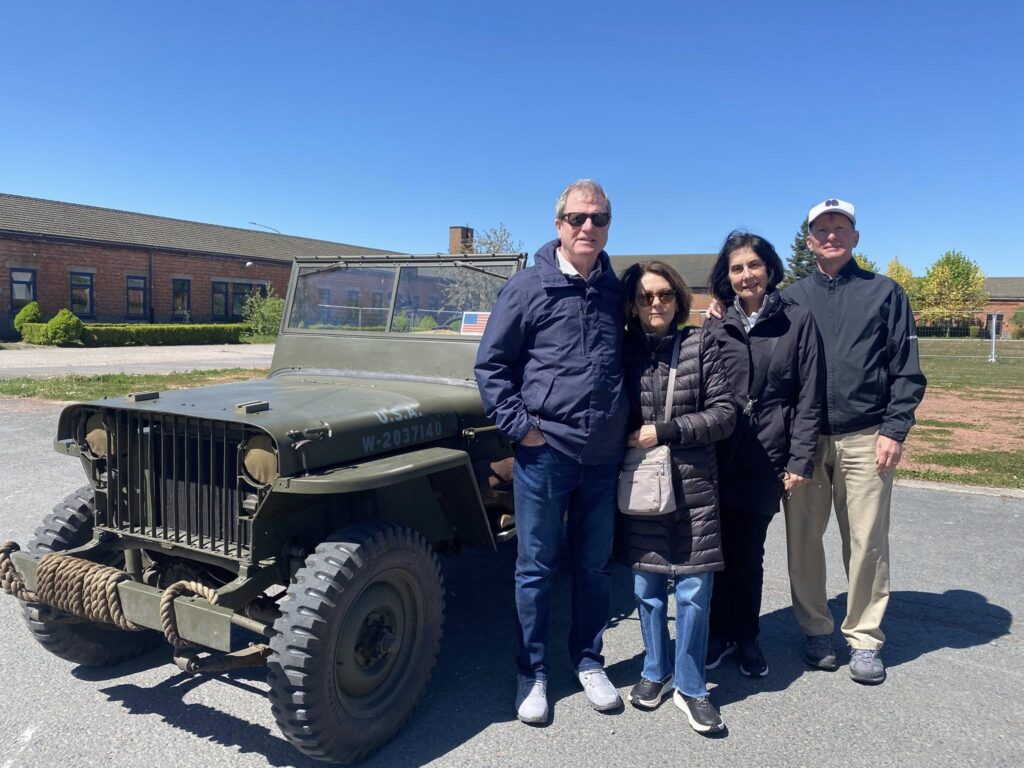

Following an American soldier's war
The records available for American soldiers differ from British or Canadian ones. A fire at the National Personnel Records Center in St. Louis in 1973 destroyed most of the Army personnel files for men discharged between 1912 and 1960. What usually survives is enough: the discharge papers the family kept, unit morning reports, after-action reports, and the division’s own history.
Send me what the family holds — a division patch, a photograph, a letter with a place name — and I work out where his unit was and when. The page about tracing an ancestor’s war grave explains the process for those who are buried here.
Starting the day from Brussels
Most American guests start in Brussels, often after flying in or arriving from Paris or Amsterdam by train. Pickup is from your hotel, the station or Brussels airport, usually around 08:30, and the day runs eight to ten hours. Henri-Chapelle is around an hour and a half from Brussels by road, Bastogne a little under two hours, so a day usually focuses on one area: the cemeteries and the northern shoulder, or Bastogne. The Brussels departure is described on the Battle of the Bulge tour from Brussels page.
Further afield, the Patton tour through Luxembourg ends at the Luxembourg American Cemetery where General Patton is buried, and the 82nd and 101st Airborne in Holland are covered on the Operation Market Garden tour.
I served as First Sergeant in the Belgian Army Airborne, 1st Para Battalion, and I am an official and permitted guide at the Battle of the Bulge sites in Bastogne. Transport is included in my own vehicle; larger groups travel by coach with a licensed professional driver. Pricing is explained under battlefield tour prices in Belgium. Call +32 497 645 645 or email peter@battlefields1.com.

American WW2 tours in Belgium — common questions
How many American cemeteries are there in Belgium?
Three. Henri-Chapelle and the Ardennes American Cemetery for the Second World War, and Flanders Field American Cemetery at Waregem for the First.
Can both WWII cemeteries be visited in one day?
Yes. They are about forty minutes apart.
Can you find where my father's unit fought?
Usually, yes. The division and regiment are enough to start; a company or battalion narrows it down.
Is Normandy possible from Belgium?
Yes, but as a separate trip. It is a long drive and deserves at least a full day.
Is a winter visit worthwhile?
Yes. December and January show the Ardennes as the men knew them, though the days are short.