

Passchendaele tour — the Ypres Salient with a private guide
A Passchendaele tour follows the Third Battle of Ypres, fought from 31 July to 10 November 1917 across a few miles of low ridges east of Ypres. British, Australian, New Zealand and Canadian troops fought through mud for more than three months to reach the village of Passchendaele, which Canadian troops finally took on 6 November.
Today the ground is farmland again. What remains are the cemeteries, the craters and the memorials — and the stories that go with them. This tour brings those together in one day, privately, at the pace you choose.
Tyne Cot Cemetery
Tyne Cot is the largest Commonwealth war cemetery in the world. Nearly 12,000 soldiers are buried here, and the memorial wall at the back carries the names of almost 35,000 more who have no known grave. Standing among the rows, you can see up the slope towards Passchendaele — the direction the attacks came from.
This is not a stop where you are handed a leaflet. At Tyne Cot I tell the stories of individual soldiers buried there, so the rows become people. If a member of your family is buried or named here, the visit is built around that grave. The Commonwealth War Graves Commission records every burial and name, with plot and row, and its database is free to search.
Zonnebeke and the Brothers in Arms memorial
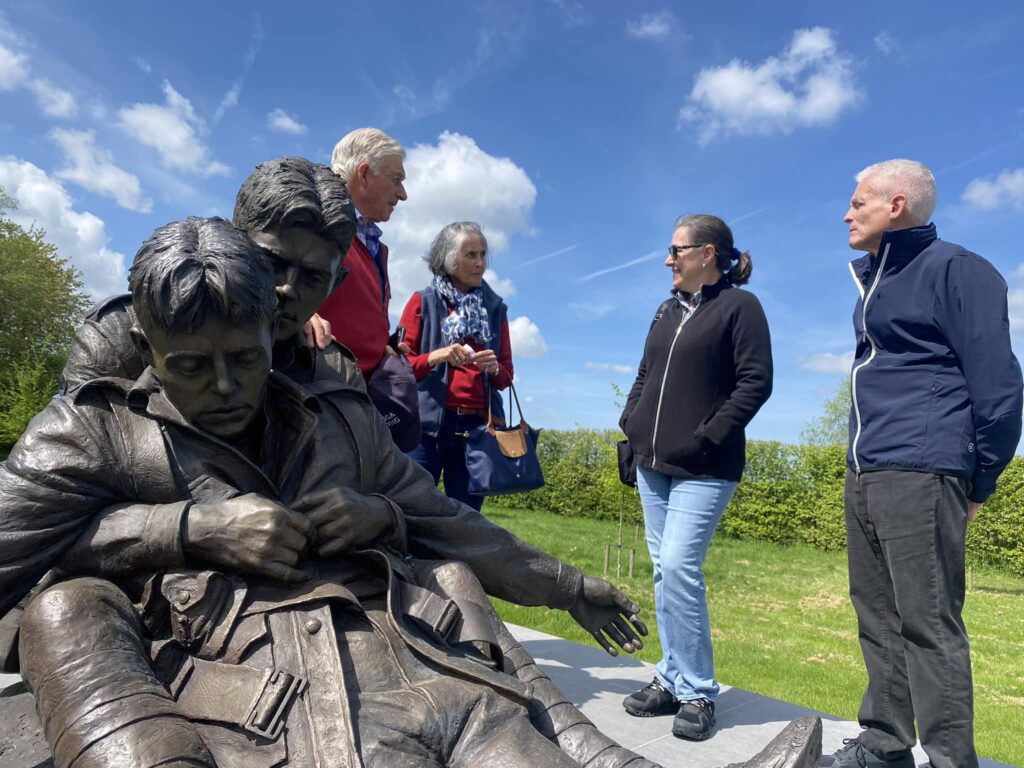
In Zonnebeke stands the Brothers in Arms memorial to Jim and John Hunter, two Australian brothers. The remains of the older brother were found here long after the war, and the search that followed revealed that he had died in his younger brother’s arms. Lunch can be taken at the restaurant of the man who led that project, with his private collection of First World War objects upstairs — a stop guests often name as a highlight of the day.
Canadian sites and the first gas attack
For Canadian visitors, the Salient holds two turning points. At Vancouver Corner, near St Julien, we talk about the first large-scale use of poison gas in April 1915 and the Canadian division that held the line. At Passchendaele itself, the Canadian memorial at Crest Farm marks the ground taken in the final weeks of the battle in November 1917.
Hill 60, Essex Farm and the rest of the Ypres Salient
Hill 60 and the Caterpillar crater show the underground war: British, Canadian and Australian tunnellers dug beneath the German positions and fired the mines that opened the Battle of Messines on 7 June 1917. At Essex Farm, the Canadian doctor John McCrae wrote “In Flanders Fields” in May 1915 beside the dressing station that still stands there. German cemeteries can be included as well, so you see both sides of the line.
The day can end in Ypres with dinner and the Last Post at eight o’clock — described on the page about the Menin Gate Last Post tour.


How the Passchendaele tour day runs
The day lasts roughly eight to ten hours and starts around 08:30, or at a time that suits your arrival. Pickup is from your hotel, train station or airport in Brussels; your hotel, the station or the river cruise terminal in Antwerp; the sea cruise terminal at Zeebrugge; or your hotel or the station in Ypres.
The general Flanders day is described on the WW1 Flanders Fields tour page. Coming from Bruges, the Dunkirk and Flanders Fields day tour combines the 1940 evacuation with Tyne Cot and the Last Post in a single day.
I have guided these battlefields since 2014, hold a 3.5-year Battlefield Tour Guide certification for both world wars, and guide in English, Dutch, French and German. Pricing is set out under battlefield tour prices in Belgium. Call +32 497 645 645 or email peter@battlefields1.com.
Passchendaele tour — common questions
Where is Passchendaele?
The village is now called Passendale, in the municipality of Zonnebeke, about ten kilometres north-east of Ypres.
Can I find a relative who fought at Passchendaele?
Yes. Search the CWGC records first, then send the name and details — see tracing an ancestor’s war grave.
Is one day enough?
For Tyne Cot, Zonnebeke, Hill 60 and the Menin Gate, yes. Add a second day for the Somme or Vimy Ridge.
Which cemeteries are included?
Tyne Cot always. Others depend on your interests and any family graves you want to visit.
Is the tour suitable for school or regimental groups?
Yes. Larger groups travel by coach with a licensed professional driver.