

CITY TOUR DINANT
Dinant is a postcard-perfect city tucked away in the Belgian Ardennes, dramatically
perched between steep limestone cliffs and the Meuse River. It’s world-famous as
the birthplace of Adolphe Sax, the man who invented the saxophone.

The Story of Mos'anne: A Face from 10.500 Years Ago
“Folks, if you look at the cliffs surrounding us here in Dinant, you aren’t just looking at beautiful scenery—you’re looking at a landscape that has been home to humans for over ten millennia. Right nearby, in the Margaux Cave (Grotte Margaux), archaeologists made a stunning discovery back in 1988. They found the remains of a woman who lived right here in the Meuse Valley around 8,500 B.C.. For decades, she was just a collection of bones, but recently, scientists from Ghent University teamed up with world-class artists to bring her back to life. Meet Mos’anne. Her name was chosen by the public and combines Meuse (the river right there) with anne, an ancient word for woman. Now, take a look at her face. Thanks to cutting-edge ancient DNA analysis, we don’t have to guess what she looked like anymore:
– The Eyes: She had striking blue eyes. This was a common trait among Western European hunter-gatherers of her time.
– The Complexion: While many of her contemporaries had very dark skin, DNA shows Mos’anne had a slightly lighter, olive-toned skin. This discovery actually shocked scientists because it proves that early Europeans were way more diverse than we used to think.
– Her Life: She lived to be between 35 and 60 years old—which was a very long life for a hunter-gatherer back then. She spent her days trekking through these very forests, foraging for hazelnuts and hunting wild game. She wasn’t alone, either. She was found in a ritual burial with eight other women, their bodies sprinkled with red ochre—a sign that her people had deep, symbolic traditions and cared for their dead with great respect. So, when you look at the Meuse River today, try to imagine Mos'anne standing on these same banks 10.500 years ago. She isn’t just a museum exhibit; she’s the face of our shared history right here in the Ardennes”
Where to See Mos'anne (2026 Tour)
The reconstruction is touring various museums in Belgium. Depending on your visit date, here is where she will be:
– Until April 11, 2026: Musée Archéologie de Haute Meuse in Godinne (very close to Dinant).
– April 12 – May 31, 2026: Espace Muséal d’Andenne (EMA) in Andenne.
– June 1 – July 15, 2026: Musée d’Interprétation Archéologique du Brabant Wallon in Nivelles.
– July 16 – August 31, 2026: Maison des Mégalithes in Wéris.
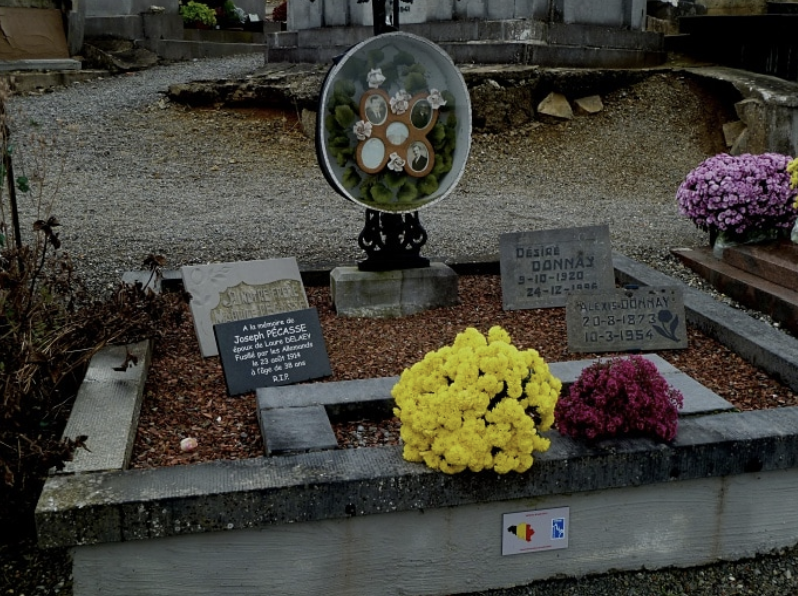
DINANT COMMUNAL CEMETERY
The cemetery is approximately 2 kilometres out from the centre of the town at a
point where the houses end. It is set back from the left hand side of the road with its own parking area.
In the cemetery many civilians are buried, killed by the Germans on 23rd
August 1914.
The city suffered devastation again at the beginning of the First World War.
On 23 August, 674 inhabitants were summarily executed by Saxon troops of
the German Army, the biggest massacre committed by the Germans in 1914.
Within a month, some five thousand Belgian and French civilians were killed by
the Germans at numerous similar occasions. Among the wounded was Lieut. Charles de Gaulle.
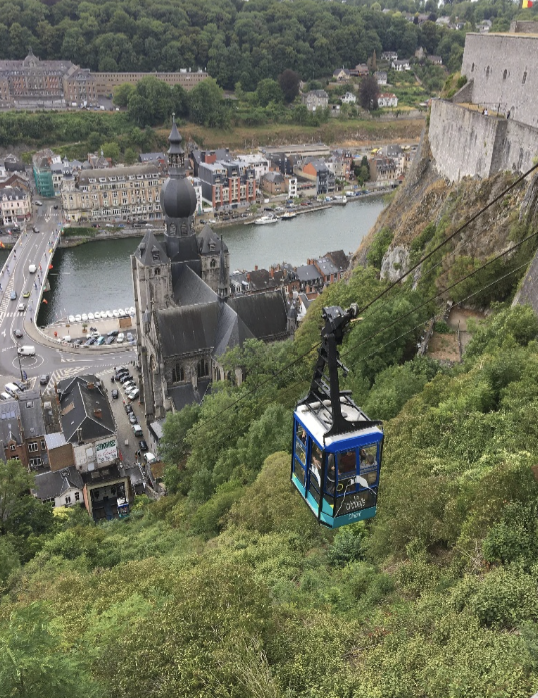
Dinant cable car
Important Update: As of April 2026, the Dinant cable car is currently closed for a major renovation. While the Citadel remains open, you must reach it by car (free parking at the top) or by climbing the 408 steps from the town center.
If you visit once it reopens or use the alternative access:
– Reservation: No advance booking is required for individual visitors; you
can buy tickets at the entrance.
– Cost: Access is paid. The entrance fee typically includes the cable car
(when operational) and the Citadel tour.
– Adults: approx. €15.00.
– Children: approx. €13.00.
– 3-in-1 Package (Citadel + Boat Cruise): approx. €25.00
Time Needed:
– Short Visit: At least 45 to 60 minutes to see the main viewpoints
and the “guillotine” courtyard.
– Full Tour: About 1.5 hours is recommended to explore the entire fortress and museum with the included HistoPad guide.
Practical Details
– Location: The lower station/stairs are located at Place
Reine Astrid, right behind the Collegiate Church of Our Lady.
– Top Entrance: For those arriving by car, use the address Chemin de la Citadelle 1, 5500 Dinant for free parking.
– Opening Hours: Currently
10:00 AM to 4:30 PM (Low Season) or 6:00 PM (Peak Season).
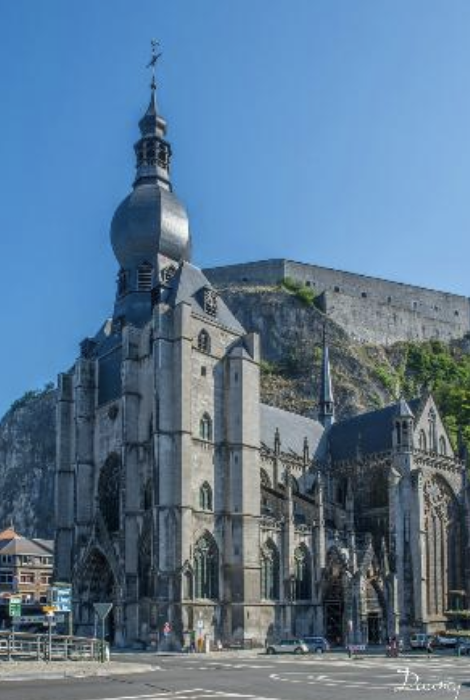
The Collegiate Church of Our Lady of Dinant
The Collegiate Church of Our Lady (Collégiale Notre-Dame de Dinant) in its current Gothic form is roughly 775 years old, though its origins date back much further.
Key Historical Timeline
– 10th Century Origins: A Romanesque-style church was first built on this site in the 900s.
– The Tragedy of 1227/1228: This original church was destroyed when a massive section of the overhanging cliff collapsed, crushing the building.
– 13th Century Rebuilding:
Reconstruction began almost immediately in the Mosan Gothic style. The choir and transept were completed around 1250. The nave and main towers followed by 1280.
– Iconic Bell Tower (1566): The famous pear-shaped (bulbous) spire that defines the skyline today was added in 1566. It was originally designed
for the town hall but was moved to the church after a fire.
– Modern Restorations
Despite its medieval appearance, the church has undergone several major
reconstructions due to severe damage:
– Sacking of 1466: Damaged during the sacking of Dinant by Philip the Good.
– World War I: The church was burned and the spire destroyed during German bombardments in 1914. It was rebuilt between 1919 and 1923.
– World War II: It suffered further damage from bombings, requiring
subsequent restoration.
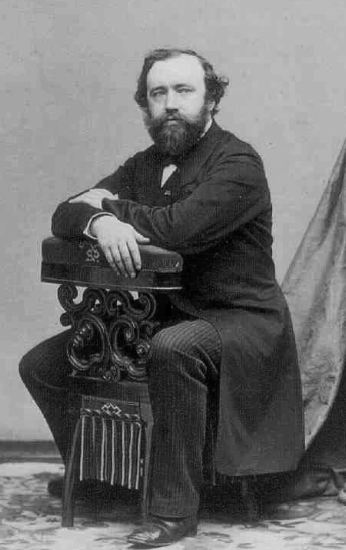
Adolphe Sax’s Birth House
The saxophone was invented in the early 1840s by Adolphe Sax and officially
patented on June 28, 1846.
Adolphe Sax’s Birth House
Adolphe Sax was born on November 6, 1814, in Dinant. The house where he was born is now an interactive interpretive center called La Maison de Monsieur Sax (Mr.’ House).
Address: Rue Adolphe Sax 37, 5500 Dinant.
– Entrance: Free of charge and no reservation is required.
– Opening Hours: Open daily from 9:00 AM to 6:30 PM or 8:30 PM (times can vary by season, but it is generally accessible all day).
– Highlights: You can see a statue of Adolphe Sax sitting on a bench right outside the entrance. Inside, the floor is
shaped like a giant saxophone, and there are exhibits about his life and various musical inventions.
Contact Your city Tours Guide in EUROPE
Ready to book your tour or have questions about a personalized city experience?
I’m here to help you plan every detail — from pickup and transport to historical sites and custom itineraries.